



Photosynthesis and Respiration CO2 and O2

The complete experiment can be found in the Biology With Vernier book, experiment 31c.
Introduction
Plants make sugar, storing the energy of the sun into chemical energy, by the process of photosynthesis. When they require energy, they can tap the stored energy in sugar by a process called cellular respiration.
The process of photosynthesis involves the use of light energy to convert carbon dioxide and water into sugar, oxygen, and other organic compounds. This process is often summarised by the following reaction:
6H2O + 6 CO2 + Light Energy —>C6H12O6 + 6 O2
Cellular respiration refers to the process of converting the chemical energy of organic molecules into a form immediately usable by organisms. Glucose may be oxidised completely if sufficient oxygen is available by the following equation:
C6H12O6 + 6 O2 —> 6H2O + 6 CO2 + Energy
All organisms, including plants and animals, oxidise glucose for energy. Often, this energy is used to convert ADP and phosphate into ATP.
Objectives
In this experiment, you will
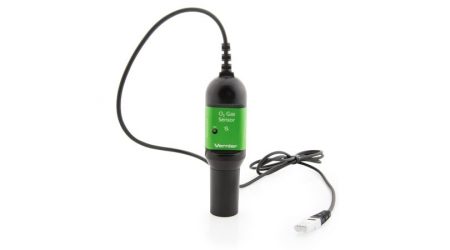
- Use an O2 Gas Sensor to measure the amount of oxygen gas consumed or produced by a plant during respiration and photosynthesis.
- Use a CO2 Gas Sensor to measure the amount of carbon dioxide consumed or produced by a plant during respiration and photosynthesis.
- Determine the rate of respiration and photosynthesis of a plant.
Sensors and Equipment
Option 1
Option 2
Related Articles

